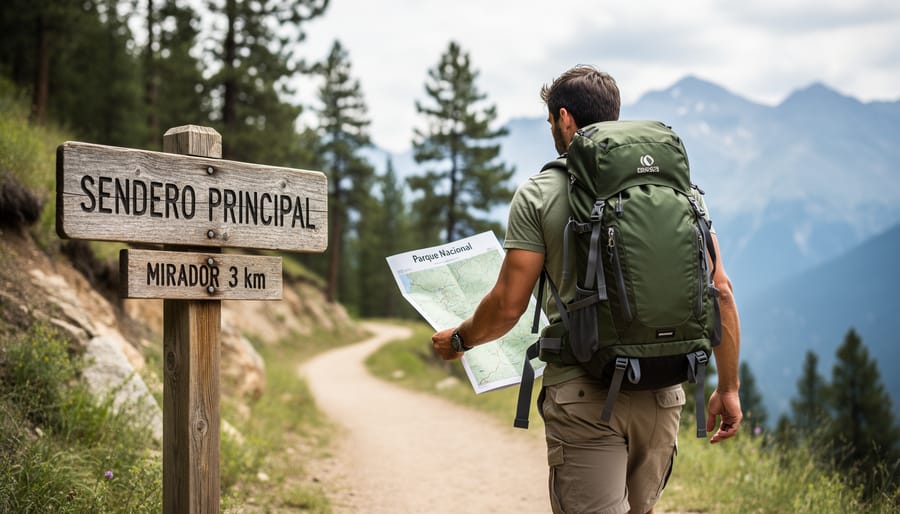
Hiking in Spanish: Essential Vocabulary and Phrases for Trails Across North America
Hiking in Spanish opens two powerful doors: it gives you the vocabulary to explore trails safely across Spanish-speaking regions and connects you with Spanish-language guided adventures throughout North America. Whether you’re planning to navigate backcountry routes in South America, communicate with guides in Mexico, or simply join a Spanish-speaking hiking group closer to home, mastering trail-specific vocabulary transforms how you experience the outdoors.
The beauty of learning hiking Spanish is its practicality. You don’t need fluency to benefit. A focused approach to essential terms like “sendero” (trail), “cima” (summit), and “refugio” (shelter) immediately makes you a more confident, safer hiker in Spanish-speaking environments. These aren’t classroom phrases but real communication tools that help you read trail markers, understand weather warnings, and connect with fellow adventurers who share your love of wild places.
Spanish-language hiking tours are also expanding across North America, creating opportunities to combine language immersion with outdoor exploration. Tour operators now offer Spanish-guided experiences that range from 3-day excursions to 23-day adventures, with August being a particularly popular month for Canadian routes. GetYourGuide runs Spanish-speaking departures from Toronto to Algonquin Provincial Park, while destinations like Jasper attract international groups to trails including Sulphur Skyline, Cavell Meadows, and the dramatic Path of the Glacier.
The practical value goes beyond conversation. Understanding Spanish trail terminology prepares you for wildlife encounters, navigation challenges, and the kind of spontaneous trail moments where quick, clear communication matters most. You’re not just learning words; you’re building bridges to new landscapes and the diverse community of hikers who explore them.
Why Spanish Matters on North American Trails
Spanish bridges gaps on the trail that maps and GPS can’t cross. When you hike in regions with strong Hispanic heritage, from the Southwest’s desert canyons to California’s coastal ranges, you’ll encounter Spanish-speaking guides, park rangers, fellow adventurers, and local communities whose knowledge runs deep. Understanding trail vocabulary lets you tap into that expertise, ask for route recommendations from people who’ve walked these paths for years, and join conversations that reveal hidden waterfalls or seasonal wildlife patterns you’d otherwise miss.
Safety is where language skills matter most. If you’re injured, lost, or facing sudden weather changes, being able to communicate clearly in Spanish with nearby hikers or emergency responders can be critical. Many popular North American trails feature bilingual signage, understanding warnings about terrain hazards, wildlife activity, or trail closures in both languages ensures you’re never second-guessing important information.
The cultural dimension enriches every step. Spanish-language hiking tours across North America create spaces where language learners and native speakers explore together, sharing stories and building friendships around campfires. In areas with deep Mexican-American or Latino roots, trails often connect to cultural sites, historical routes, and natural landmarks that carry Spanish names and narratives. Knowing the language transforms these hikes from simple walks into layered experiences where landscape and heritage intertwine.
Community building happens naturally when you speak the language. You’ll find yourself welcomed into group hikes, invited to share meals at trailheads, and connected to networks of outdoor enthusiasts who organize adventures in Spanish. This isn’t just about vocabulary, it’s about becoming part of a vibrant, growing community that sees trails as places for connection as much as exploration.
Core Hiking Vocabulary in Spanish
Trail Navigation and Directions
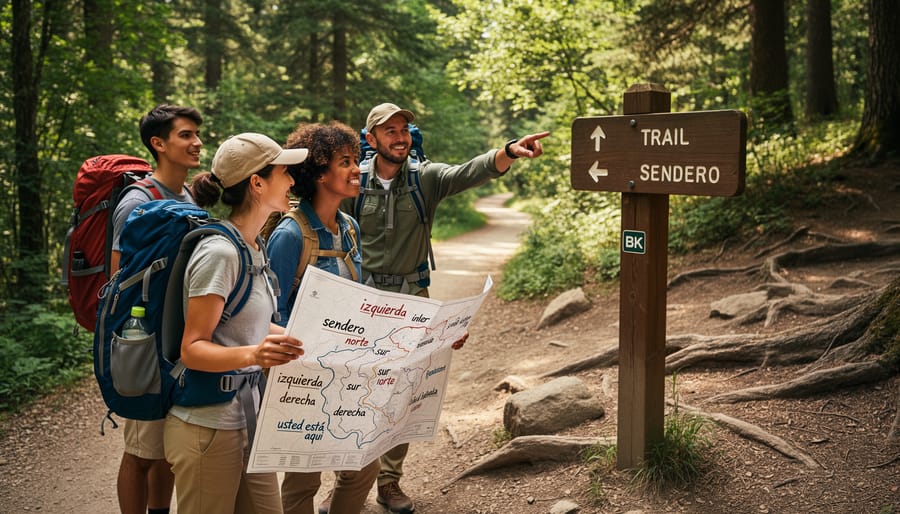
When you encounter fellow hikers or guides on North American trails, a few key phrases help you navigate confidently. Start with “¿Dónde está el sendero?” (Where is the trail?) or “¿Por dónde se va a…?” (Which way to…?) when you need directions. To understand what’s ahead, ask “¿Cuántos kilómetros faltan?” (How many kilometers remain?) or “¿Cuánto tiempo tarda?” (How long does it take?).
Trail difficulty levels follow a simple pattern: “fácil” means easy, “moderado” indicates moderate, and “difícil” signals difficult or challenging terrain. You’ll also hear “empinado” for steep sections and “plano” for flat stretches. When discussing elevation changes, particularly switchbacks in hiking the term “zigzag” works universally, though some guides use “curvas cerradas.”
Directional phrases include “todo recto” (straight ahead), “a la izquierda” (to the left), and “a la derecha” (to the right). To confirm you’re on track, ask “¿Vamos bien?” (Are we going the right way?). These basics transform uncertainty into clear communication, whether you’re reading bilingual trail markers or chatting with Spanish-speaking hikers sharing the path.
Safety and Emergency Phrases
When hiking in remote areas, knowing emergency Spanish can literally save lives. Start with the essentials: ¡Ayuda! (AH-yoo-dah) and ¡Socorro! (soh-KOH-roh) both mean “Help!” and will get immediate attention. If you’re injured, say “Estoy herido” (es-TOY eh-REE-doh) for “I’m injured” or “Necesito ayuda médica” (neh-seh-SEE-toh ah-YOO-dah MEH-dee-kah) for “I need medical help.”
For navigation emergencies, “Estoy perdido” (es-TOY pehr-DEE-doh) means “I’m lost,” while “Hay peligro” (eye peh-LEE-groh) warns of danger ahead. Weather threats require quick recognition: tormenta (storm), niebla (fog), and avalancha (avalanche) appear on warning signs across bilingual trail systems.
Wildlife encounters need clear communication too. Beyond carrying bear bells know “¡Cuidado con el oso!” (watch out for the bear) and “No te muevas” (don’t move). Practice these phrases before your hike so they come naturally under stress, when fumbling for words wastes critical seconds.
Spanish-Language Hiking Tours in Canada
Canada’s wilderness beckons Spanish-speaking adventurers through a growing network of guided hiking experiences designed specifically for those who prefer exploring in their native language. From the rugged peaks of the Rockies to the pristine forests of Ontario, multi-day hiking tours conducted in Spanish are opening doors to immersive backcountry experiences where language is never a barrier to adventure.
Currently, over 120 hiking and trekking trips operate across Canada, with options ranging from compact 3-day weekend getaways to immersive 23-day expeditions that traverse multiple provinces. August stands out as the peak month for these adventures, when stable weather and abundant daylight create ideal conditions for tackling challenging alpine routes. For 2026 bookings, many operators now offer free cancellation up to 7 days before departure, giving you flexibility as you plan your adventure around work schedules or weather forecasts.
| Destination | Duration Range | Featured Routes |
|---|---|---|
| Algonquin Provincial Park | 3-7 days | Forest trails, lake portages, wildlife viewing |
| Jasper National Park | 5-12 days | Sulphur Skyline, Cavell Meadows, Skyline Trail |
| Canadian Rockies Circuit | 14-23 days | Multi-park routes, glacier walks, mountain passes |
Eastern Canada’s Algonquin Provincial Park serves as an accessible entry point for Spanish-language hiking groups, with departures from Toronto making it convenient for international travelers. The park’s network of backcountry trails weaves through dense boreal forests where moose sightings are common and the sound of loons echoes across countless lakes.
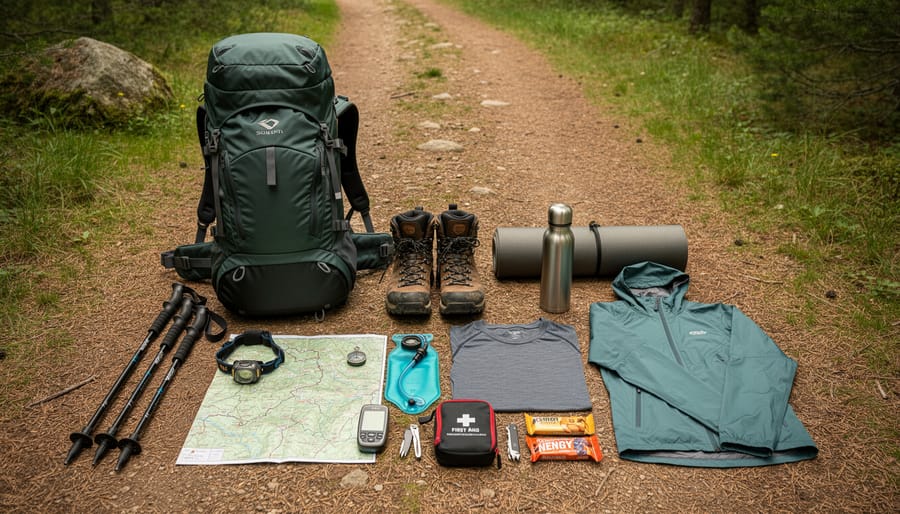
Out west, Jasper National Park offers some of the most dramatic alpine hiking terrain accessible with Spanish-speaking guides. Routes like Sulphur Skyline deliver panoramic mountain vistas after a challenging climb, while Cavell Meadows showcases wildflower-carpeted meadows beneath the Angel Glacier. The multi-day Skyline Trail, perhaps Jasper’s most celebrated backcountry route, takes hikers above treeline for extended periods, where you’ll need a quality sleeping pad to ensure comfortable rest at high-elevation campsites where temperatures drop sharply after sunset.
For extended adventures, the Path of the Glacier route and Wilcox Pass provide access to some of Canada’s most pristine wilderness, where your Spanish-speaking guide can share ecological insights while navigating ancient ice fields and reading subtle changes in mountain weather patterns.
Building Your Spanish Trail Vocabulary Naturally
The best way to learn Spanish trail vocabulary is through real hiking situations, not textbook drills. Start by joining Spanish-speaking hiking groups in your area or online communities where members organize bilingual trail outings. These groups naturally blend conversation practice with actual outdoor experiences, so you’re learning the words “sendero” and “cima” while walking a trail, not just memorizing flashcards at home.
Language exchange apps work well when you focus them specifically on outdoor topics. Find a conversation partner who also hikes, and structure your sessions around planning imaginary trips or discussing recent adventures. This approach keeps the vocabulary relevant and sticks in your memory because you’re attaching words to real scenarios you care about.
Spanish hiking podcasts and outdoor travel shows provide passive exposure that builds your ear for trail terminology. Listen while you drive or during gym workouts, and you’ll pick up pronunciation and conversational rhythms without dedicated study time. Look for content featuring Latin American mountain guides or travel hosts exploring trails.
Bilingual trail guides and maps offer another practical learning tool. Regions like Mont-Tremblant provide bilingual signage, giving you instant translation context as you hike. You can compare English and Spanish terms side by side while experiencing the actual terrain they describe. This works particularly well for hiking Tremblant where French-English-Spanish resources are increasingly available.
Build your skills gradually through consistent exposure rather than cramming. Your comfort level will grow naturally as you encounter the same terms repeatedly in different hiking contexts across weeks and months of practice.
Conversational Spanish for Group Hikes
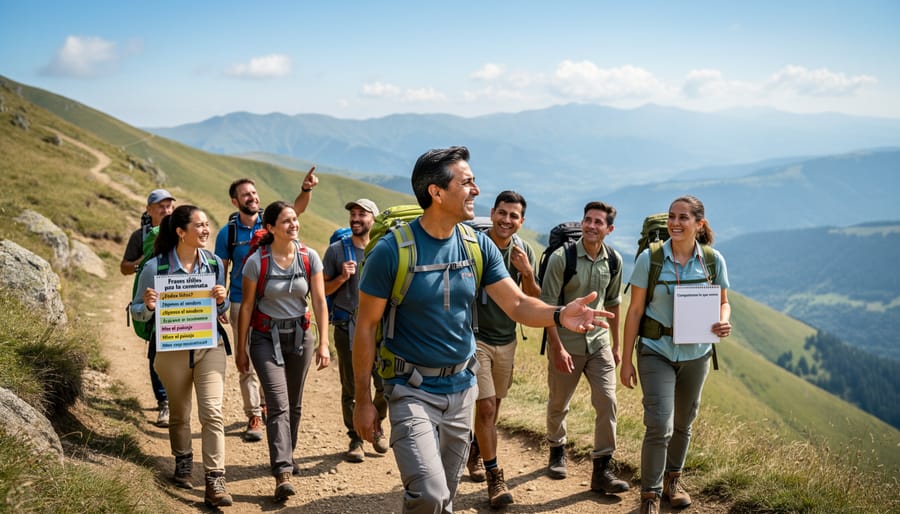
Sharing the trail with Spanish-speaking hikers creates connections that go beyond the scenery. Start with simple introductions: “Me llamo Sarah” (I’m called Sarah) and “Soy de Vancouver” (I’m from Vancouver) open doors immediately. When someone asks “¿De dónde eres?” (Where are you from?), you’ve got your conversation starter.
Trail conditions come up constantly during group hikes. “El sendero está resbaladizo” (The trail is slippery) warns companions about hazards, while “Hay mucho barro” (There’s a lot of mud) prepares everyone for messy sections ahead. If you’re struggling with elevation, “Estoy cansado” or “Estoy cansada” (I’m tired, masculine/feminine) signals you need a slower pace without embarrassment.
How do I ask someone to slow down on a trail?
Say “¿Podemos caminar más despacio?” (Can we walk more slowly?). Pronounce it: POH-deh-mohs kah-mee-NAR mahs dehs-PAH-see-oh.
What’s the best phrase for coordinating a water break?
“¿Descansamos aquí?” (Should we rest here?) works perfectly. The response “Sí, buena idea” (Yes, good idea) shows agreement.
How do I point out wildlife without scaring it away?
Whisper “Mira” (Look) followed by the animal name: “Mira el ciervo” (Look at the deer). Keep your voice low and gesture gently.
Wildlife sightings turn into shared excitement with phrases like “Veo un pájaro grande” (I see a big bird) or “¡Qué hermoso!” (How beautiful!). When the views get stunning, “Mira las montañas” (Look at the mountains) invites everyone to pause together. For break coordination, “¿Tienes agua?” (Do you have water?) checks on hydration, while “Descansemos aquí” (Let’s rest here) proposes a stopping point. These phrases build camaraderie naturally, turning strangers into trail companions.
What You Need to Know Before You Go
Mastering basic Spanish trail vocabulary opens doors to richer hiking experiences across North America, especially in regions with strong Hispanic communities and Spanish-language tour offerings. You’ll find it most valuable in popular destinations like Jasper, Algonquin Provincial Park, and throughout the Southwest, where you’re likely to encounter Spanish-speaking guides, fellow hikers, and bilingual trail signage.
Start small rather than aiming for fluency. Learn five to ten phrases before your next hike, practice them out loud, and build from there through real conversations on the trail. The beauty of learning hiking Spanish is that you can apply it immediately in authentic situations, whether you’re joining a guided tour in Canada, chatting with other hikers, or simply reading trail markers with better understanding.
Language learning enhances every outdoor adventure by connecting you more deeply with the landscape and the people who share it. At Stanley Kayaking, we believe inclusive exploration means embracing opportunities to communicate across cultures, and the trail offers the perfect classroom for putting new vocabulary into practice. Pack your phrasebook alongside your gear and let curiosity guide both your journey and your learning.